Summary
Universities produce more data per student than most corporations produce per customer, and use less of it. This lecture is the applied companion to Volume 6 — The Informed Citizen — and focuses on the higher-education side of the volume: admissions modelling that predicts fit rather than just yield, learning analytics that identifies at-risk students early enough to intervene, faculty resource planning that treats scholarship time as a scarce asset, and the alumni-engagement models that fund the whole system. The material treats the institution as an operating system with observable signals, and asks what a serious BI programme would do with them. The talk addresses the sensitive parts openly — student privacy, faculty autonomy, the politics of measurement — and offers the maturity framework that Volume 6 uses to sequence the work. Aimed at university CIOs, provosts, and institutional-research leads, with material that applies at the community-college scale as much as at the R1 scale.
Related volumes
This lecture connects to the following volume of the series. Each one deepens the material at book length:
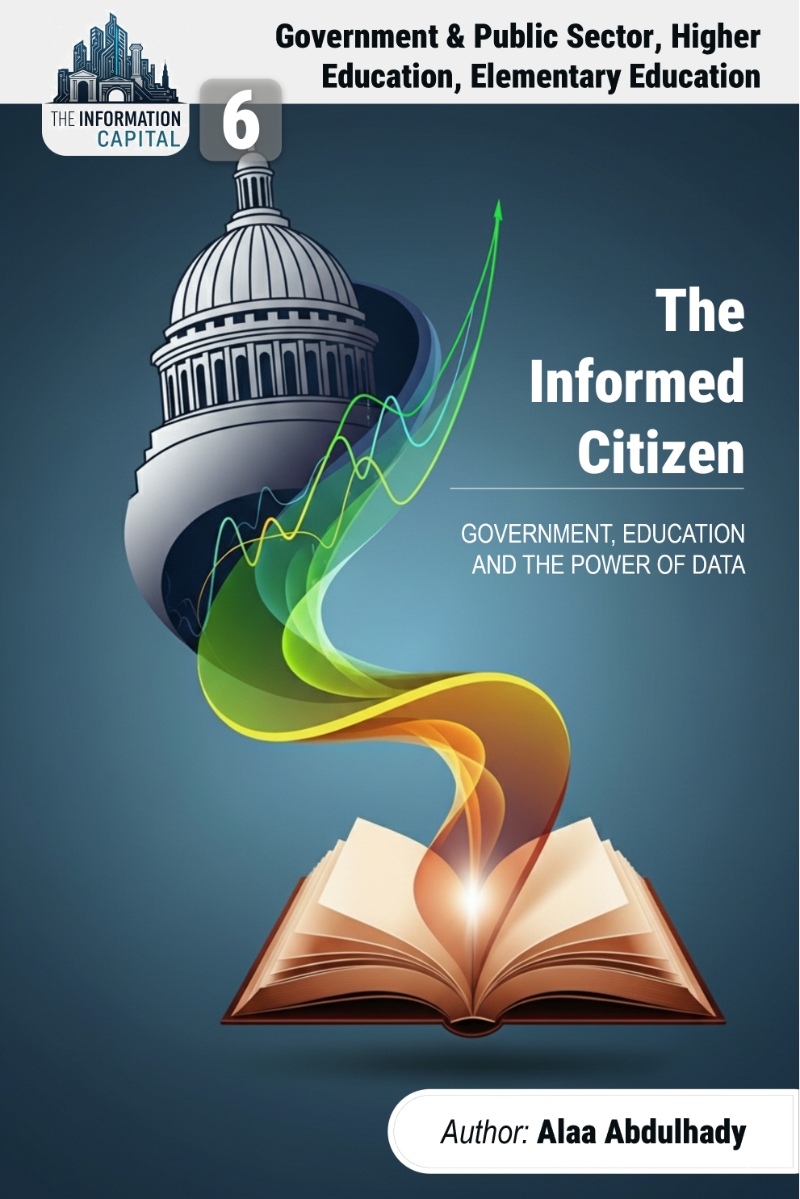 Vol 6 · The Informed Citizen
Watch on YouTube
Open on YouTube to switch caption languages, add to your library, or watch the full 12-lecture playlist. The embedded player above forces captions on in the page's active language when a track exists.
Read the series
The Information Capital is an eight-volume business-intelligence field manual by Alaa Abdulhady, published by Advanced Management Solutions. Buy the series on Amazon in hardcover, paperback, or Kindle. For speaking, framework licensing, or press, email noreply@amsol.ca.