Summary
Healthcare has the most fragmented data topology of any industry the series covers, and the highest cost of getting it wrong. This lecture is the applied companion to Volume 3 — Curing with Code — and walks through how a working BI programme is built inside a hospital or a payer, where interoperability standards, regulatory boundaries, and clinical judgement all constrain what analytics can do. The material covers three concrete workflows: patient-outcome prediction from admission telemetry, quality-of-care measurement across service lines, and the operational efficiency work that keeps a service viable without asking clinicians to become data analysts. The talk names the standards (FHIR, HL7), the failure modes, and the maturity indicators that separate a programme that has landed a dashboard from one that has changed a care pathway. It is aimed at hospital CIOs, chief medical information officers, and payer analytics leads — but the framework is the same one Volume 3 applies across life sciences and pharmaceuticals.
Related volumes
This lecture connects to the following volume of the series. Each one deepens the material at book length:
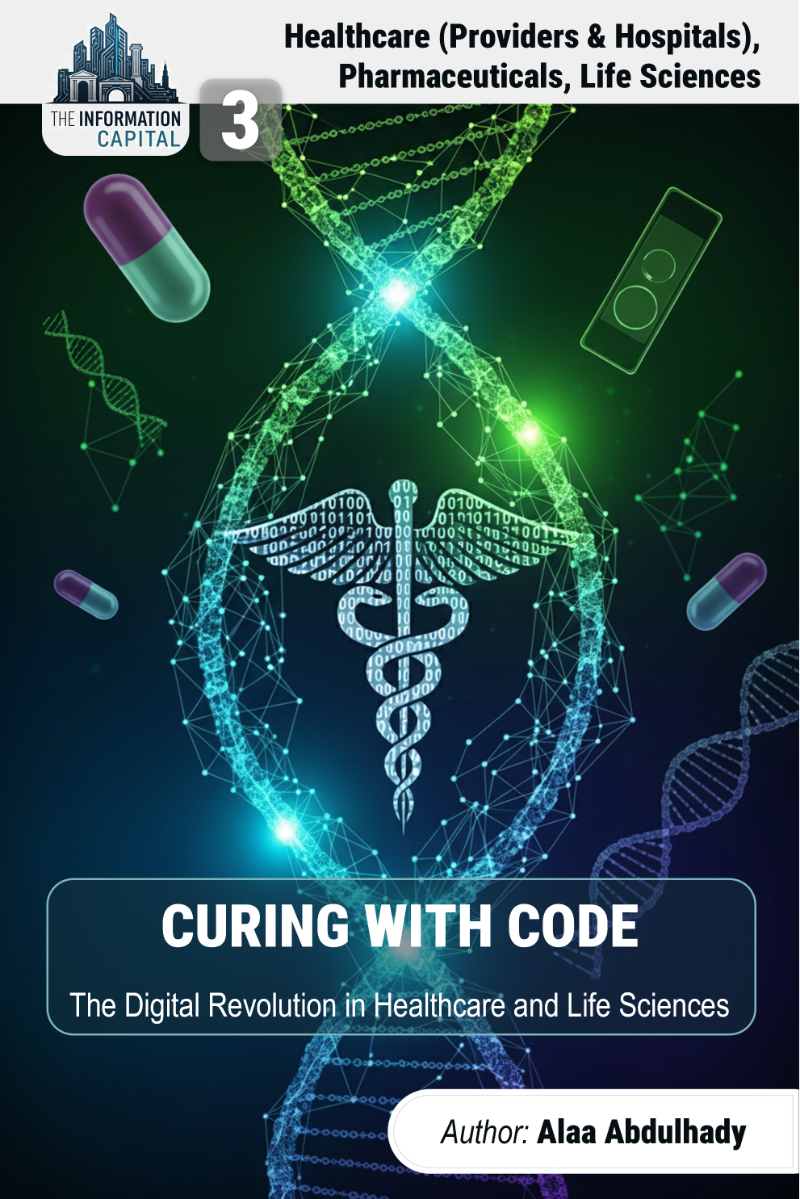 Vol 3 · Curing with Code
Watch on YouTube
Open on YouTube to switch caption languages, add to your library, or watch the full 12-lecture playlist. The embedded player above forces captions on in the page's active language when a track exists.
Read the series
The Information Capital is an eight-volume business-intelligence field manual by Alaa Abdulhady, published by Advanced Management Solutions. Buy the series on Amazon in hardcover, paperback, or Kindle. For speaking, framework licensing, or press, email noreply@amsol.ca.